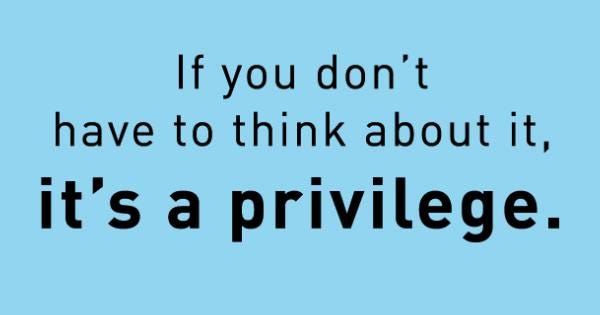
Week 1: Assignment A: Power, Privilege, and Difference – Johnson
Talking Points:
1 – (beginning): The beginning of the reading includes a
quote from Johnson that says, “…you can’t deal with a problem if you don’t name
it: once you name it, you can think, talk, and write about it” (p.11). This quote
specifically made me think about the summer training I received with Teach for
America, where we learned about naming and norming certain things. If we become
aware of the issues and the roles in which we play in our society, then we can
take action steps to work towards a solution. Without calling yourself out on
certain privileges you may have, there is no way that you can contribute to a
solution because you are still unaware of your own identity
2 – (middle): “Ignoring privilege keeps us in a state of
unreality, by promoting the illusion that difference by itself is the problem”
(p. 16) This quote in itself highlights the important statements Johnson is
making about how we view ourselves in society and the interactions we have with
one another. Another component of this involves the fact that our ‘differences’
are things that we think we know about a person, without truly getting to know
them. So, ignoring the things that make us individuals and unique can really be
what sparks the ways in which privilege and oppression manifest themselves.
3 – (end): The ending of the article explains what privilege
is and how we see it in society. Johnson discusses that there are two types of
privilege: “unearned entitlements” and “conferred dominance” (p. 25-26). A
large portion of the ending has to do with the ways in which we see privilege
in everyday life. This connects back to the quote extracted from the middle of
the reading because it is these social constructs that have been created that
allow for privilege and oppression to show themselves in our society. Despite
that, I think it is important to leave the conversation knowing this
distinction made by Johnson that states “Finally it is important to point out
that belonging to a privileged category that has an oppressive relationship
with another isn’t the same as being an oppressive person who behaves in
oppressive ways” (p. 41).
 Argument Statement:
Johnson argues that our society has a huge issue right now
that involves the issues of privilege and oppression and the ways in which they
can hurt those around us. Making ourselves aware of the definitions of these
words and the ways in which they show themselves in society can make us more
informed members of the community, allowing us to contribute to a solution.


No comments:
Post a Comment